
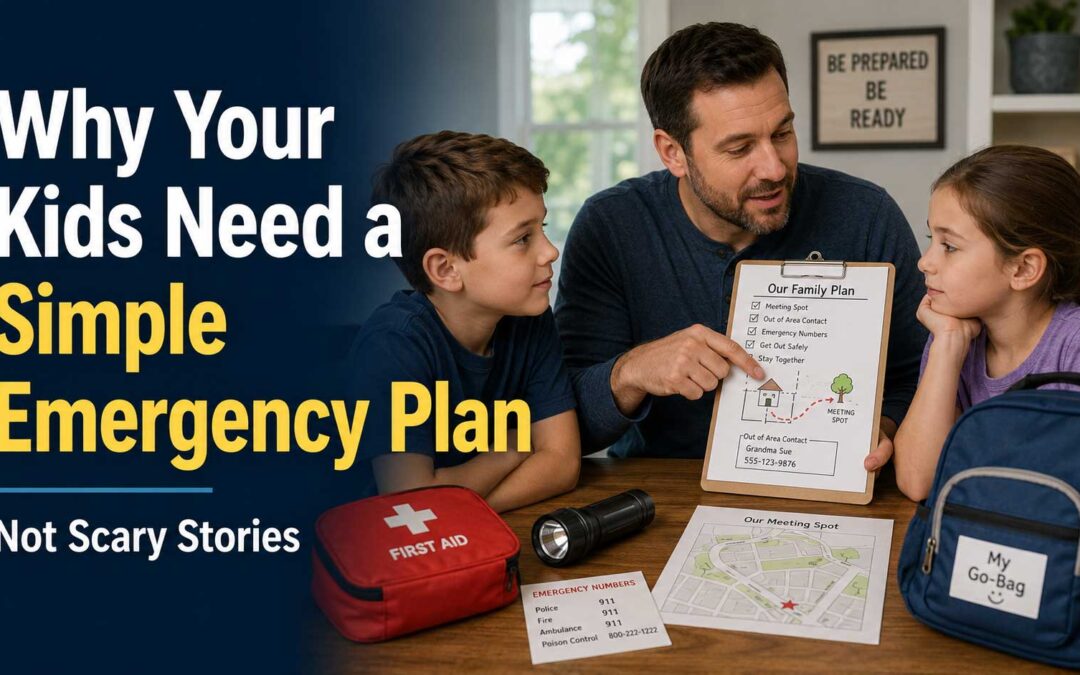
Kids Don't Need to Be Scared. They Need a Job.
Most parents fall into one of two camps on this. Either they never bring up emergencies at all, because they don't want to scare their kids, or they overcorrect and start talking about worst-case scenarios in detail, which does scare their kids. Both approaches miss the actual target, because neither one gives a child the thing that actually helps: a clear, calm answer to "what do I do if this happens."
Think about a fire drill at school. Nobody comes home traumatized from one. Kids don't lie awake at night worried about fires because they practiced walking to a line-up spot. The drill isn't scary — it's just a routine. Alarm sounds, line up, walk outside, wait for the teacher. That's it. The clarity is what makes it boring instead of frightening, and boring is exactly what you want.
Your house needs the same thing school already gives them. Not a heavy conversation about disasters, just the same plain, practical information: what happens if the power goes out, what happens if you need to leave the house fast, what happens if you can't reach each other by phone. Kids who know the answer to those questions feel like they have a role. Kids who don't know the answer feel like they're just along for the ride when something goes wrong — and that's where the fear actually comes from.
I think about this the same way I think about teaching someone a trade skill. Nobody hands an apprentice a welding torch and says "figure it out if something catches fire." You show them exactly where the extinguisher is, exactly what to do, and you practice it once so it's not a mystery. Kids learn emergency procedures the same way — as a skill, not a scary story.
Make It Concrete, Not Abstract
Young kids especially can't do much with vague reassurance. Telling a six-year-old "we'll handle it if something happens" doesn't mean anything to them, because they have no idea what "handling it" looks like or what they're supposed to do.
But telling that same kid, "if the power goes out and it gets dark, your flashlight is on the shelf in the hall closet, and that's your job to grab it" gives them something real. It's a fact they can hold onto, not a feeling they have to sit with.
This is really the whole trick to reducing a kid's anxiety about this stuff: specific beats vague, every time. A fuzzy sense that "bad things could happen" is scarier than a clear rule of "if X happens, we do Y," because the unknown is what kids' imaginations run wild with — not the known.
A few ways to make this real instead of theoretical:
- Walk the house with your kids and physically point things out — don't just describe them. Show them the flashlight shelf, the first aid kit, the meeting spot outside if you need to leave quickly.
- Write down a phone number or two — a grandparent, a trusted neighbor — somewhere your child can find it if a phone isn't working.
- Teach one scenario at a time. Don't try to cover outages, evacuations, and medical situations in a single sitting. Pick whichever is most likely where you live, teach it well, and move to the next one later.
- Match the complexity to the kid. Younger children do best with a single, simple rule per scenario. Older kids and teens can handle a real decision tree — "if this happens, do this; if that happens instead, do that."
The tone matters here as much as the content. Treat this the same way you'd teach a kid to cross the street or answer the door — practical information delivered matter-of-factly, not a dramatic sit-down conversation.
Give Kids a Real Job, Scaled to Their Age
Kids feel less anxious and more capable when they have an actual role during an emergency, instead of being a passenger while the adults handle everything. Even small children can take on something real.
Ages 4–7 — keep it simple and physical:
- Grabbing their own flashlight from its designated spot
- Carrying a small backpack with a few comfort items during an evacuation
- Knowing how to get to the family meeting spot and staying there
- Being able to say their full name, address, and a parent's name to a helper if needed
- Helping a younger sibling or a pet during a leave-the-house situation
These are small tasks, but they shift a child from "being helped" to "helping" — and that shift does most of the work in cutting down fear.
Ages 8–12 — add real responsibility:
- Knowing how and when to call 911, and what information to give the dispatcher
- Checking on a younger sibling and walking them through the plan
- Grabbing specific items during an evacuation — medication, a pet's leash, important papers
- Knowing more than one way to reach a parent
- Understanding the difference between "we shelter in place" and "we leave"
- Being able to follow the family plan even if they get separated from an adult
This age group can genuinely hold onto more nuance. They can understand that different situations call for different responses, and they can be trusted with tasks that meaningfully help.
Teenagers — treat them like the near-adults they are:
- Full knowledge of the family's emergency procedures, not a simplified version
- A real say in decisions during an actual event
- Responsibility for their own go-bag or personal supplies
- The ability to care for younger siblings if a parent is temporarily unreachable
- Knowing how to access emergency cash or key documents
- Basic first aid or CPR training, if you can arrange it
Teenagers who are actually included — given real information and real responsibility — tend to rise to it. The teens who freeze during a real emergency are usually the ones who were never told anything and are working it out for the first time under pressure.
Practice Without Making It Feel Like a Drill
Talking through a plan helps. Actually practicing it is what makes it stick. A procedure a kid has physically walked through a few times becomes a routine. A procedure they've only heard about once becomes something they're trying to remember for the first time in an actual emergency — which is the worst possible time to be figuring it out.
Practice doesn't need to feel like practice. "Let's see how fast we can all get to the meeting spot" lands completely differently than "we're doing an evacuation drill," even though it's teaching the exact same skill.
A few low-key ways to build this in:
- Power outage practice: Turn the power off on purpose one evening. Play a board game by lantern light, make a simple no-cook meal, let everyone get used to moving around the house in the dark. It stops being scary once it's just a slightly different evening.
- Evacuation practice: Time how fast your family can gather essentials and get to the car. Turn it into a beat-your-best-time challenge. You'll also find out what's actually slowing you down — which is useful information on its own.
- Communication practice: Have your kids actually text or call your out-of-area emergency contact once, so the number and the process aren't unfamiliar. Practice having them call from a neighbor's phone if that's part of your plan.
Keep the tone light. This is about building familiarity, not testing performance. If something goes wrong during practice, that's the point — you found the gap while the stakes were zero, instead of finding it during a real event. Frame it as "we're learning this so we know what to do," not "we're practicing in case something terrible happens." Same activity, very different message.
Common Mistakes Parents Make Here
Most well-meaning parents trip over the same handful of things when they try to do this well.
- Showing kids graphic disaster content to "drive the point home." News footage of destroyed homes or survival movies doesn't build preparedness — it just gives kids nightmares without teaching them anything useful. They don't need to see the worst-case outcome to understand that having a plan matters.
- Making emergency prep a constant topic of conversation. If your household is always talking about what could go wrong, always buying more gear, always running drills, kids pick up on the underlying message that danger is always right around the corner. This should be a small, occasional part of family life — not the theme of it.
- Using fear to enforce the rules. "You could get hurt in the dark if you don't know where the flashlights are" creates worry without building any actual skill. "Here's where the flashlights are so you can find them" teaches the same lesson without the scare tactic.
- Handing kids adult-sized responsibility. Giving a child a real, age-appropriate role is good. Letting them believe the family's safety depends on them getting everything exactly right is too much weight, and it produces anxiety instead of confidence.
- Sharing your own worst-case thinking with them. If you're personally anxious about disaster scenarios, work through that with another adult. Kids need your calm, practical guidance — not a window into your own worry.
- Doing it once and never again. A single conversation fades. A plan nobody revisits or practices again in six months is basically forgotten by the time it's actually needed.
Starting the Conversation Tonight
If you haven't talked to your kids about any of this yet, it can feel awkward to bring up out of nowhere. You don't have to make it a big moment.
- Use a natural trigger. A storm in the forecast is a perfectly normal reason to say, "we might lose power tonight, let me show you where the flashlights are." No drama required — it's just useful information about something that might actually happen.
- Connect it to what they already know. Most kids have done fire drills or lockdown drills at school. Ask what they remember. Point out that a home plan works the same way — everyone just knows what to do, not because something's about to happen.
- Frame it as a capability, not a fear. Kids generally want to be seen as more capable. Position this the same way you'd position learning to cook or handle money — a skill that makes them more independent, not a warning about danger.
- Start with the least scary scenario. Power outages are usually the easiest entry point — common, not inherently dangerous, and something most kids have already lived through once.
- Keep the first conversation short. "If the power goes out, here's what we do" can be a five-minute conversation. You don't need to cover every scenario in one sitting.
- Check back in later. Some kids shrug it off immediately. Others process it and come back with questions a day or two later. Be available for that without making it a bigger deal than it needs to be.
The Bottom Line
Kids are more resilient than most parents give them credit for. A calm conversation about where the flashlights are, practiced once or twice, doesn't traumatize a child — it does the opposite. What actually leaves kids scared and confused is being in the middle of a real emergency with zero information and zero role, watching adults handle something they don't understand and can't help with.
Give your kids the plain version: what to do, where things are, who to call. Practice it the way you'd practice anything else worth knowing — a couple of times, without pressure, until it's just a normal thing they know how to do. That's not fear. That's a kid who knows they can handle it.