
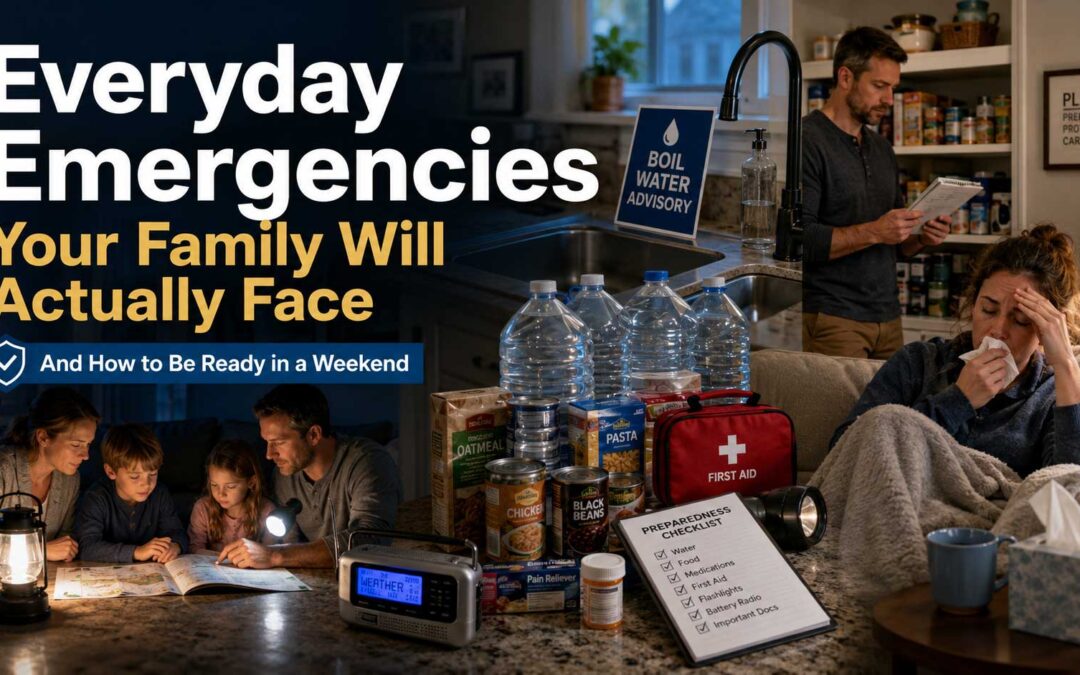
You're Prepping for the Wrong Disaster
Ask most people what "emergency preparedness" means and you'll hear the same short list: hurricanes, earthquakes, tornadoes, maybe a wildfire if they live out west. Big, dramatic, made-for-TV events. If you live in a place where those things actually happen, sure, plan for them.
But here's the problem. Those aren't the emergencies that are going to hit your house this year. The ones that will are smaller, quieter, and a lot more boring — which is exactly why nobody prepares for them.
I've spent a career moving between trades and small businesses — running a print shop, hauling freight, fixing small engines, keeping chickens alive through a Pennsylvania winter. If there's one thing that work teaches you, it's that the stuff that actually stops you cold is rarely the dramatic stuff. It's the truck that won't start on the coldest morning of the year. The part that's on backorder. The one guy who knows how the whole operation runs calling in sick. Households run the same way.
The power goes out for three days. The water main breaks. The person who runs the household gets the flu at the worst possible time. Nobody declares a state of emergency for any of that. No news crew shows up. But it still wrecks your week if you haven't thought about it in advance — and it costs almost nothing to fix that.
This isn't a guide to bunkers and freeze-dried food buckets (which costs a not-so-small fortune). It's a plan for the stuff that's actually statistically likely to happen to your family, with the mistakes families make along the way and how to close the gaps this week, not someday.
Emergency #1: The Power Outage That Lasts Days, Not Hours
A short outage is an inconvenience. You light a candle, complain a little, and it's back on before dinner. The outage that actually tests a family is the one that stretches into day two or three — usually during the worst possible weather to be without climate control.
Picture it: it's 97 degrees or it's 12 degrees, the power drops in the afternoon, and the utility company's estimate keeps sliding — first "a few hours," then "by tomorrow," then "we're working on it." You're stuck at home with whatever is already in your pantry, your closets, and your junk drawer.
Here's what actually goes wrong for unprepared families:
- Nobody can find working light. There's one flashlight, the batteries are corroded, and everyone's using their phone as a flashlight — which kills the one device they need for information and communication.
- The temperature turns dangerous faster than expected. Indoor temps in a hot climate can climb past 95°F within a few hours with no AC, which is a real risk for kids, older adults, and anyone with a heart or respiratory condition. Cold works the same way in reverse.
- The food question turns into guesswork. Nobody in the house actually knows how long the fridge or freezer stays safe once the door's been opened a few times, so food either gets tossed too early or eaten too late.
- Phones die and nobody has a way to charge them, which means no updates on restoration time and no way to reach anyone if something else goes wrong.
None of that requires an expensive fix. It requires a plan you made once, on a calm afternoon, instead of one you're improvising by candlelight.
What actually solves it:
- LED flashlights or lanterns for every household member, with batteries checked twice a year — this is a $40–$50 problem, not a $400 one.
- A simple temperature plan: extra blankets and layered clothing for winter, battery or crank-powered fans and a hydration plan for summer.
- A few days of shelf-stable food that needs zero cooking — canned proteins, peanut butter, crackers, dried fruit.
- A battery-powered or hand-crank radio that gets local weather and emergency broadcasts without relying on cell service.
- A basic rule for the fridge and freezer: keep the doors closed as much as possible, and know that a full freezer holds safe temperatures roughly 48 hours if left unopened, while a fridge is good for about 4 hours.
The families who get through a multi-day outage calmly aren't the ones with a whole-house generator. They're the ones who spent thirty minutes thinking it through before it happened.
Emergency #2: The Day Your Water Stops Running
Nobody thinks about water until the tap runs dry or the utility sends out a boil-water notice. Then it becomes obvious, fast, just how much of daily life depends on clean water showing up on demand.
This isn't rare. Water main breaks shut down service to entire neighborhoods for hours or days at a time. Contamination events — a chemical spill, a sewage backup, a treatment failure — trigger boil-water advisories that make tap water unsafe to drink without treating it first. Drought can force mandatory restrictions. Even a power outage can knock out the pumps that move water through a system, independent of whether the water supply itself is fine.
Most households have a gallon or two of bottled water sitting around, which sounds like something but really isn't. That covers drinking water for one person for a day or two — and does nothing for cooking, cleaning, hygiene, or the toilet.
Where families get blindsided:
- Water gets used dozens of times a day without anyone noticing — handwashing, brushing teeth, coffee, cooking rice or pasta, taking medication, wiping down counters.
- Toilets are the first real problem. A family of four flushing normally can go through 20–30 gallons a day just on that. People either stop flushing, which turns unsanitary fast, or they burn through their stored water trying to keep flushing normally.
- Hygiene slips quietly. People skip handwashing to ration water, which raises the risk of getting sick right when you're already dealing with a disruption.
What actually solves it — and it's genuinely inexpensive:
- Store one gallon of water per person, per day, for at least three days. That's 9 gallons for a family of three, 12 for a family of four — small enough to fit under a bed or in a closet. Rotate it every six months by using it up and refilling.
- Keep a simple water filter on hand, like a Sawyer Mini or LifeStraw. These run around $20 and filter thousands of gallons, which extends your supply well past what you can physically store.
- Know your low-water sanitation options ahead of time: you can manually flush a toilet by pouring about 1.5 gallons directly into the bowl, switch to disposable plates and utensils to cut dishwashing water, and use hand sanitizer as a stopgap for handwashing when water is tight.
Families caught flat-footed by a water outage are the ones who never once thought about it because the tap has always worked. The families who shrug it off are the ones who had water stored, a filter in a drawer, and a sanitation plan already worked out.
Emergency #3: When the Person Who Runs the House Goes Down
Every household has someone — a parent, an older teen, sometimes a grandparent — who quietly holds the whole operation together. They know everyone's schedule, who has practice and when, what's in the fridge, which bills are due, which login goes with which portal, and who takes what medication.
Then that person gets sick, gets hurt, or has to leave town for a family emergency — and everyone else discovers that none of that information lived anywhere except in one person's head.
This is a different kind of emergency. Nothing outside the house is wrong. The lights work, the water runs, there's no storm. But daily life still falls apart, because the household's operating system just went offline.
What typically happens next:
- Kids miss practice or activities because no one else knew the schedule.
- Meals don't happen because nobody else knows what's in the house or how to put it together.
- Appointments get missed because they only existed on one calendar.
- Prescriptions run out because only one person was tracking refill dates.
- Bills go unpaid because only one person knew what was due and when.
Meanwhile, the person who's actually sick or dealing with the crisis is now also stressed about whether the household is falling apart without them — which makes whatever they're going through worse.
What actually fixes this isn't splitting every chore evenly during normal weeks. It's making sure the information isn't trapped in one person's memory:
- Put the family calendar somewhere every adult can see and access — not buried in one person's head or one person's phone.
- Write down the basics of a normal week: who needs to be where, and when.
- Keep a simple, shared list of logins for school portals, medical accounts, and other essential services.
- Document where important paperwork lives, and who's taking what medication, and when.
- Build a one-page "household operations" sheet that any capable family member could pick up and run the house from for a week — schedules, key contacts (school, doctor, service providers), and which bills get paid and when.
If you're a single-parent household, this matters even more, because there's no second adult to automatically step in. That means lining up outside support before you need it — who your kids could stay with if you're hospitalized, who could handle school pickup and logistics for a few days, who knows your household well enough to keep it running. Those conversations need to happen while things are calm, not while you're already in the middle of a crisis.
Emergency #4: Getting Hurt or Sick When the Roads Are Genuinely Dangerous
Ice storm, whiteout conditions, flash flooding — officials are telling everyone to stay off the roads unless it's truly necessary. And that's exactly when someone in your house gets hurt or takes a turn for the worse.
Maybe a kid falls and their arm looks wrong. Maybe someone's having severe abdominal pain. Maybe a chronic condition flares up hard. Now you're weighing bad options against each other: risk the roads to get to urgent care, call 911 for something that might not rise to that level, or wait it out and hope it improves — knowing that waiting could let a real problem get worse.
Most families struggle here because they've never actually drawn the lines. They don't have a clear answer to "does this need 911 no matter what the roads look like," versus "this needs care, but we can get there carefully ourselves," versus "this is miserable, but it can wait until the roads clear." Without those lines already drawn, people either panic and take on unnecessary risk, or downplay something that needed attention sooner.
What actually helps, worked out before anyone's hurt:
- Basic first aid knowledge that goes past band-aids — how to immobilize a suspected fracture, how to control serious bleeding, and what symptoms mean "call 911 regardless of the weather."
- A stocked first aid kit with real supplies: splinting material, real bandages (not just adhesive strips), instant cold packs, and over-the-counter pain and fever medication.
- A decision framework talked through in advance, while everyone's calm — not invented on the spot while someone's hurt and scared. Agree ahead of time on what automatically triggers a 911 call, what means "we drive carefully," and what can reasonably wait.
- A relationship with your medical provider's after-hours line. Most pediatricians and family doctors have a nurse line for evenings and weekends that can help you triage over the phone instead of guessing.
The families who handle a medical scare during bad weather well aren't the ones who got lucky. They're the ones who had already answered "what do we do if this happens" before it happened.
The Mistakes That Undo Good Intentions
Plenty of families do think about preparedness — and still end up unprepared, because of a handful of avoidable mistakes.
- Buying gear before making a plan. A closet full of supplies doesn't help if nobody knows where anything is or how to use it under stress. Decide what you'd actually do first, then buy what supports that plan.
- Storing water and food once and forgetting about it. Batteries corrode, water needs rotating, and food expires. A supply nobody checks for two years isn't a supply — it's clutter with a use-by date.
- Keeping the plan in one person's head. Whether it's the household calendar, the medication schedule, or where the flashlights are kept, information that only one person knows isn't a plan — it's a single point of failure.
- Preparing for the dramatic disaster and ignoring the boring one. A generator for a hurricane that may never hit is a bigger investment, with a lower odds of ever being used, than $50 of flashlights and a few gallons of stored water that you're statistically far more likely to actually need.
- Never talking through the decision points out loud. Whether it's "when do we call 911" or "when do we toss the fridge food," families that never discuss these ahead of time end up making high-stress decisions for the first time in the worst possible moment.
- Treating preparedness as a one-time project instead of a habit. Batteries get checked once and never again. Water sits unrotated for years. A plan made once and never revisited quietly goes stale.
Where to Start This Week
These four situations — a power outage that runs into days, a water service disruption, the household manager going down, and a medical situation during dangerous weather — don't make the news. They're too common and too local for that. But they hit thousands of families every single week, and most of those families handle them badly simply because they never gave the scenario thirty minutes of honest thought.
That's really the whole secret here. This doesn't take a bunker, a generator, or a four-figure budget. It takes a few hours of thinking things through and maybe $150–$200 in basic supplies, spread out however your budget allows.
Pick the scenario that worries you most, or the one that's most likely where you live. Walk through it honestly: What would actually go wrong? What would you need in that moment? What gap exists in your house right now? Then close one gap this week — not all four, just one. That's what separates the families who ride out an ordinary emergency calmly from the ones improvising in the dark, literally and otherwise.